
Routine Testing & Series 600 Earthworks Tests
General classification tests are undertaken to determine the index properties of subsoils and determine their suitability for reuse as general fill materials based on the criteria specified by SHW or TII Series 600
Natural moisture content test
Measures the amount of water present in a soil sample as it exists in its natural state. This test provides key information about the soil's in-situ condition and is fundamental for soil classification, strength analysis, and engineering behaviour studies, where it relates to the soil sensitivity, stiffness, density & compressibility.
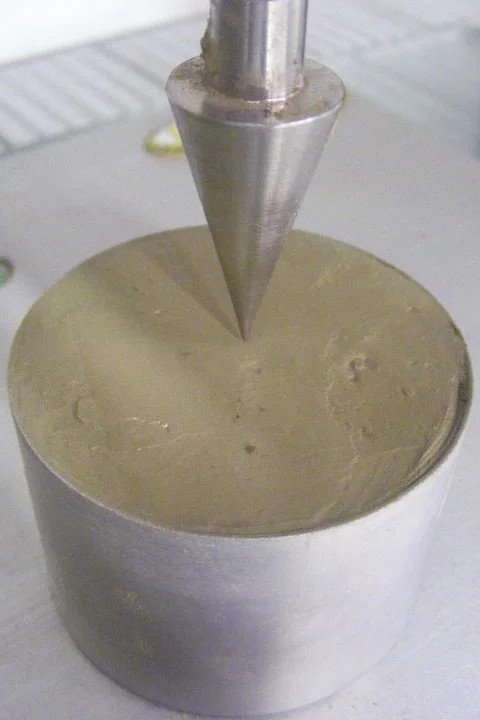
Atterberg Limit Tests
A set of standardised laboratory tests used in geotechnical engineering to determine the critical water contents (consistency limits) at which fine-grained soils (like clays and silts) transition between different states: solid, semi-solid, plastic and liquid
The tests classify the soil plasticity, which predicts their engineering behaviour (e.g., sensitivity, compressibility, shear strength, swell-shrink potential), and distinguish between clays and silts based on standard soil classification systems.
Particle Size Distribution test
A standard classification test that determines the distribution of particle sizes in a soil sample, expressed as percentages by dry mass in different size ranges (e.g. gravel, sand, silt, clay). The test reflects the grading and uniformity coefficient of coarse soils and determines the % fines content, which is fundamental in determining the suitability of general fill materials for reuse in earthworks based on Series 600.
Sedimentation (Hydrometer or Pipette Methods)
The test is typically undertaken alongside particle size distribution tests to extend the grading curve below 63 μm and determine the silt and clay content of the fine soil fraction, where the test measures the percentage of particles remaining in suspension at specific time intervals after sieve analysis removes coarser particles.
Bulk & Dry Density
The test is based on linear measurement of undisturbed or remoulded clay samples, which is used to calculate the mass per unit volume of soil, which relates to the in-situ density, and engineering behaviour of general fill materials (e.g. degree of compaction, load-bearing capacity, settlement potential), where the test is often related to laboratory compaction and CBR Tests.
Particle Density
The test measures the density or specific gravity of the solid soil particles, excluding voids, water, and air between them. (e.g. higher for iron-rich soils, lower with organic matter)
Moisture Condition Value
The standard earthwork classification test is primarily used to determine the suitability of cohesive glacial till soils for reuse as general fill material in earthworks, following Series 600, where the test measures the compactive effort required to achieve near-full compaction of a soil sample at its natural moisture content (single stage test) or at four points.
Remoulded Undrained Triaxial
A standard Series 600 test used to determine the undrained shear strength (c_u) of general fill material in earthworks, when remoulded at its natural state. The test sample is typically compacted using a standard 2.5kg Proctor rammer in a CBR mould or U100 tube, and the cylindrical specimen is then subjected to a quick undrained test in a triaxial cell under confining pressure.
Compaction Tests (Proctor Rammer 2.5 & 4.5kg & Vibrating Hammer Methods)
This standard set of earthwork classification tests is typically used to measure the degree of compaction of general fill materials, based on Series 600 or performance specification. The five-point test plots the relationship between moisture content and dry density of a soil under controlled compactive effort, which determines the optimum moisture content (OMC) and maximum dry density of the material. The results are typically used as a CQA compaction control test and relate to the in-situ density and natural moisture content of the fill material in embankments and road subgrades.
Remoulded CBR
The standard earthworks test can be undertaken as a single-point determination at natural moisture content, or as a multi-point test, where it is typically performed alongside laboratory compaction tests on remoulded samples compacted in a CBR mould. The test is used to evaluate the stiffness of general fill materials for road and pavement design.
BRE 1 Concrete Classification (pH & Water-Soluble Sulphate)
This standard electrochemical test determines the relevant design sulphate class required for protection of buried concrete foundations in aggressive ground, where the test is typically based on 2:1 water/soil extract for sulphate and soil pH level. Tests are also conducted on groundwater samples.