
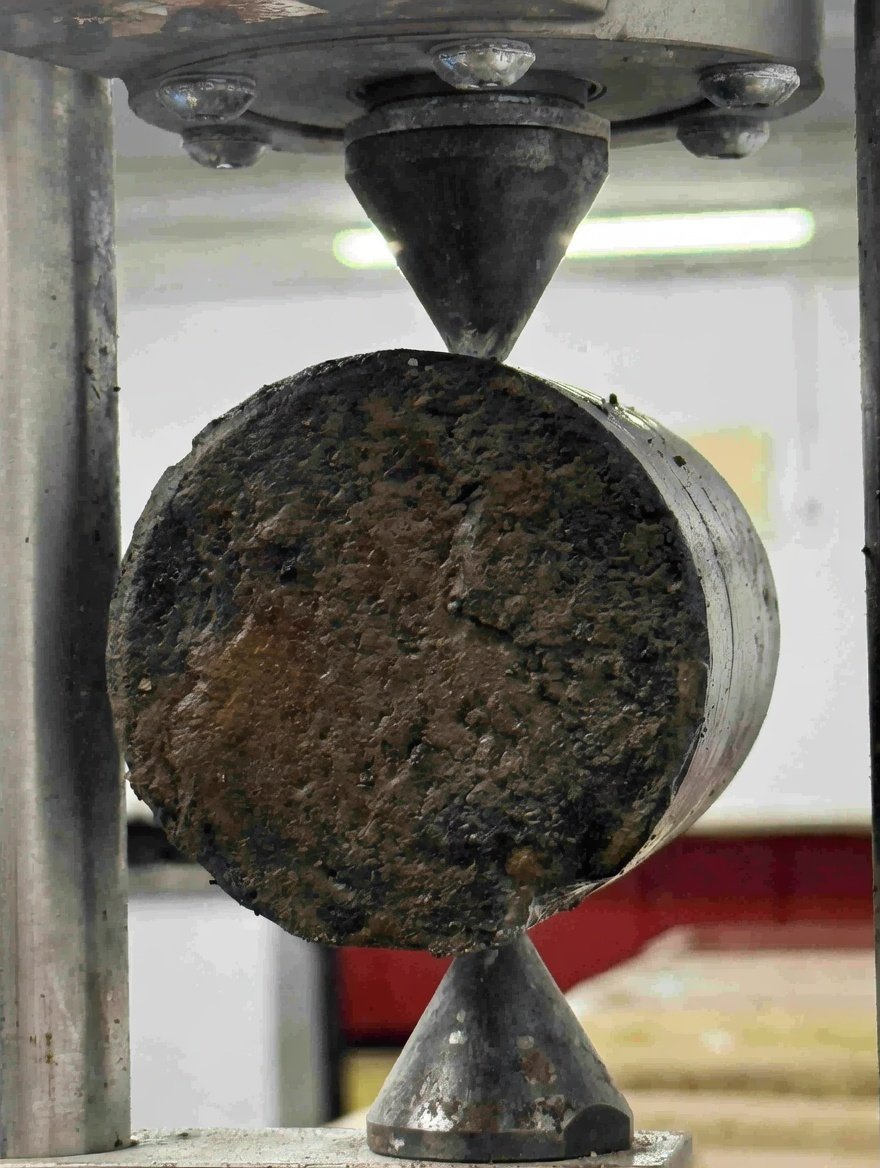
Rock Strength & Durability Tests
In combination with detailed petrographic examination and logging of index properties of rock cores (TCR, SCR, RQD and FI), laboratory tests can be conducted on core specimens to determine the intact rock strength, where the data can be used to classify the rock quality based on Rock Mass Rating (RMR) and assess the excavation requirements. In addition, abrasion tests can be conducted on the large bulk samples to assess the durability of aggregates for use in road pavement foundations.
Point Load Index Tests (Axial & Diametrial)
Point load tests are performed on intact rock core specimens and block samples, where it provides an index value that can be correlated with an equivalent unconfined compressive strength. This allows the intact rock strength to be characterised rapidly without the need for sample preparation, where the test can be used to characterise the rock quality and rippability, and inform the design of foundations, and rock face stabilisation works. Anisotropy can be assessed by comparing axial and diametral results.
Unconfined Compressive Strength (UCS) Tests
The test is performed on a prepared rock core specimen or block sample, and measures the maximum compressive stress that the rock specimen can withstand when loaded axially with no lateral (confining) pressure. The peak strength reflects a fundamental property, which is used in the geotechnical design of rock cuttings and foundations.
The enhanced version of the standard UCS test can be used to calculate the Youngs Modulus value and Poisson's Ratio (ν) of the rock, based on the ratio of lateral strain to axial strain in the elastic range.
LA Abrasion Test
The Los Angeles durability test measures the resistance to fragmentation and abrasion of coarse aggregates by tumbling a sample with steel balls in a rotating drum for 500 revolutions. The test is used to assess aggregate suitability of the stone for use in the sub-bases, and wearing courses of road pavements.
Aggregate Crushing/Abrasion/Impact Value
These standard durability tests measure the resistance of coarse stone aggregates to abrasion, crushing and impact. The results are reported as percentage values, where lower values relate to higher-quality materials that would be suitable for reuse in road bases, surfacing, and concrete.
Aggregate Crushing Value (ACV) Measures resistance of coarse aggregate to crushing under a gradually applied compressive load, where the test records the % of material passing 2.36 mm sieve after 40-ton load.
Aggregate Impact Value (AIV) Measures resistance of coarse aggregate to sudden impact/shock loading, where the test records the % of material passing 2.36 mm sieve after 15 standard hammer blows.
Aggregate Abrasion Value (AAV) Measures resistance of coarse aggregate to surface wear from rubbing and abrasion, where the test records the % mass loss after tumbling with abrasive charge.
Slake Durability Tests
Assesses the resistance of weak rocks—particularly shales, mudstones, siltstones, claystones, and other argillaceous (clay-bearing) rocks—to weathering, specifically the weakening and disintegration caused by cycles of wetting and drying, often combined with mild abrasion.
The test simulates short-term weathering processes (such as exposure to water and subsequent drying that can cause slaking, where the rock breaks down into smaller particles or mud.
Ten percent Fines Value
Measures the resistance of coarse aggregates (such as crushed stone, gravel, or other granular materials to crushing under a gradually applied compressive load. It indicates the mechanical strength and durability of aggregates when used in applications like road base, sub-base, concrete, or asphalt mixes.
The test determines the force (load) required to produce exactly 10% fines—fine material passing a 2.36 mm sieve—expressed as a percentage of the original dry sample mass. A higher TFV means the aggregate is stronger and more resistant to crushing (better quality for load-bearing applications).