
Soakaway Tests
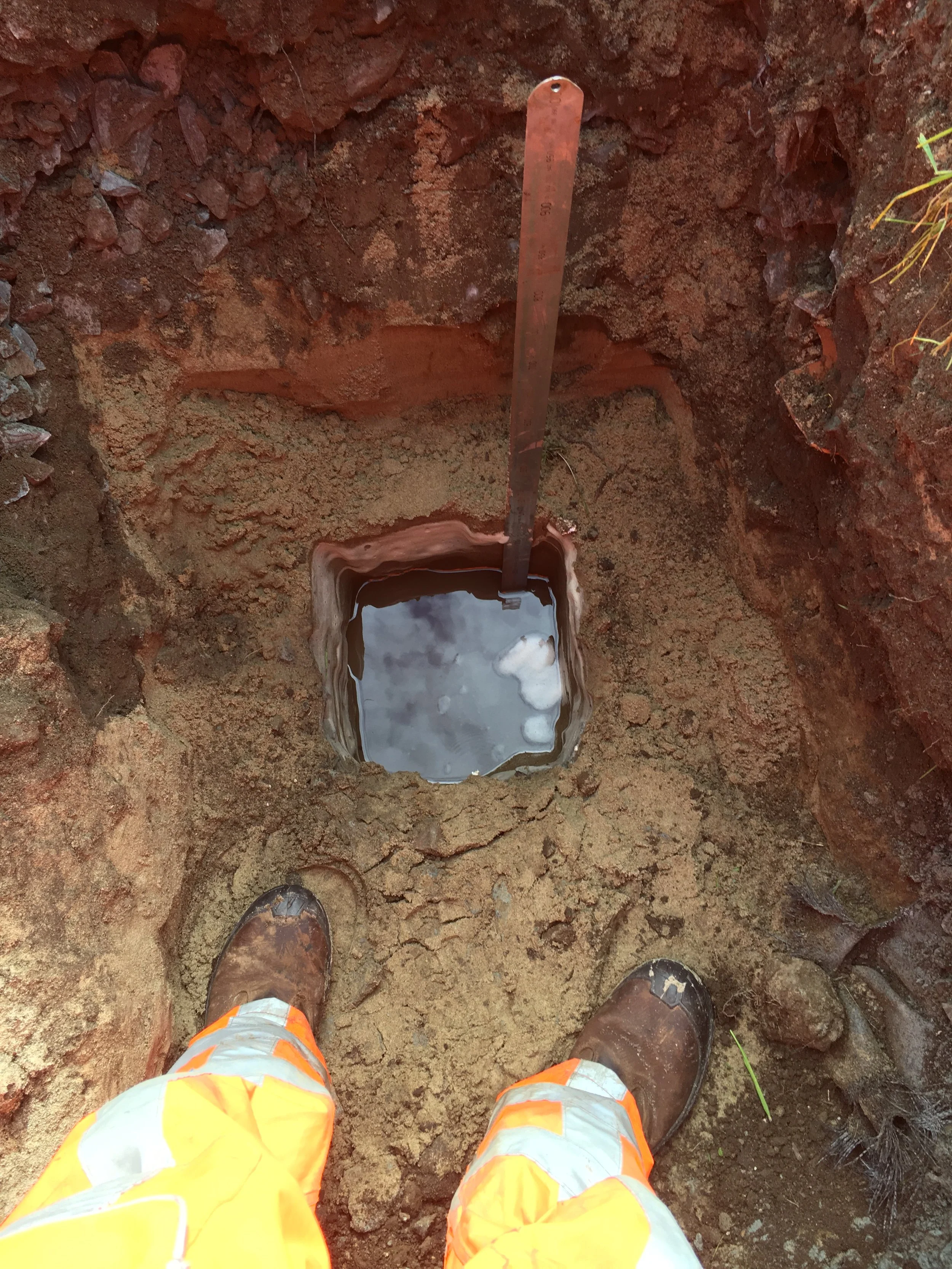
Soakaway tests are commonly undertaken in trial pits or hand dug sumps, where the results are used to calculate the permeability and infiltration rate of the ground. The two most test common methods are outlined below
-
Commonly used for design of a SUDs drainage system to determine the storm storage capacity for a soakaway. The test is usually undertaken in a machine dug trial pit of measured dimensions, which is either fenced off if left open overnight, or infilled with gravel and installed with observation tube to permit readings. The pit is then pre-soaked before being filled with water from a bowser or IBC cubes. Readings are then undertaken at preset time intervals, where the fall in water level is plotted on a chart, where the soil infiltration rate is calculated from the time taken for the water level to fall from 75% to 25% of the effective depth of the pit, which reflects the effective storage volume
-
The BS and NIEA approved test method, is commonly used in the design of drainage fields for wastewater treatment. The test is similar to the BRE method, whereby hand dug sumps of measured depth and square dimensions are excavated in the base of a trial pit at the planned invert level of the soakaway system. The sumps are then filled with water, where readings of the fall in water level are undertaken at staged time intervals. The measured readings are then plotted on a chart, where the soil infiltration rate is calculated from the time taken for water level to fall between 75 and 25% of the effective depth of the pit. The test is then repeated, where the average infiltration rate is calculated from three consecutive tests