
Pavement Design & Compaction Control Tests
In-situ CBR tests are undertaken to inform the design of road sub-base and capping layer thickness’, working platforms for crane bases, and compaction control test on earthworks projects. Testing is undertaken in accordance with BS1377-9 and DMRB CD225 guidelines, and Series 600 Earthworks
-
The test is generally undertaken at the design formation level of sub-grade and capping layers during the initial phases of road construction, or during placement and compaction of general fill materials in embankments. The test records the displacement (settlement) properties of the ground under applied load cycles. Loads are applied in increments to a standard 450mm steel plate using a calibrated hydraulic jack, when digital gauges are used to record the deflection of the plate. The results are plotted graphically and used to calculate the sub-grade surface modulus and estimated CBR value for the formation, which is related to the design thickness charts for sub-base and capping layer according to the foundation class of the road
-
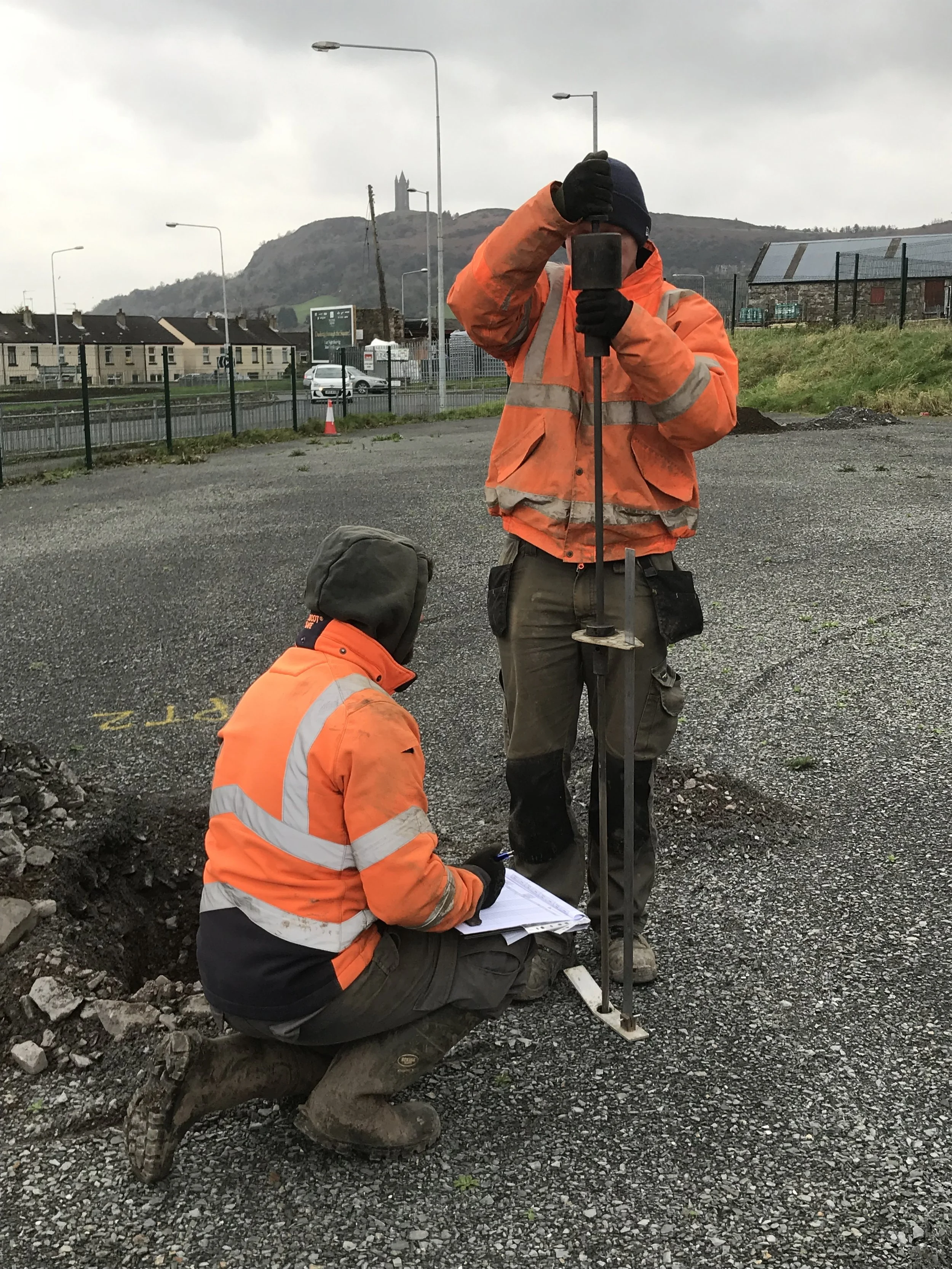
The dynamic cone penetrometer (DCP) or lightweight TRL (Transport Research Laboratory) probe can be used to rapidly characterise the variation in the stiffness of the superficial soil layers to a depth of 900mm. The test measures the penetration of probe in blow increments, where the probe is driven into the ground using a 8kg sliding hammer falling through set height of 575mm. Test results are plotted on a chart, which allows the variation in CBR and sub-grade stiffness modulus values to be calculated for different soil layers. This allows soft layers with a CBR of <2.5% to be identified and removed to provide a stable road foundation
-
The original method developed by the California Department of Transportation employs a cylindrical plunger that is pushed into the ground at a steady rate, where measurements of the applied load and displacement are plotted on a CBR chart and used to calculate a CBR value, which relates to a standard aggregate composed of California Crushed Limestone
-
The hand shear vane provides an accurate in-situ method for determining the stiffness or relative consistency of cohesive soils. The test is undertaken using either a 19 or 33mm diameter vane, which is embedded into the soil and rotated at a steady rate until shear occurs. The peak torque reading recorded by the gauge is then correlated with the undrained shear strength of the soil, where tests are typically performed in the base/walls of trial pits, on block samples, or alongside CBR tests as a compaction control test to check the stiffness of a rolled formation surface in earthworks/road construction.
-
Sand Replacement tests are used to evaluate the in-situ density of natural or compacted soils; where the tests are commonly used in highway design to estimate the relative density of emplaced base course or subgrade materials, where the results can also be used as compaction control test to calculate the degree of compaction when related to laboratory compaction tests. Tests involve excavating a 200mm deep cylindrical flat-bottomed hole from the surface where samples are retained for moisture content determination. The hole is then filled with a measured volume of clean, dry sand, which is poured into the hole using a calibrated cylinder. The weight of sand required to fill the hole is then related to the weight of the removed soil, and used to calculated the bulk density of the in-situ material