
Consolidation & Shear Strength Tests
Laboratory consolidation and shear strength tests are undertaken on high quality Class 1 or 2 undisturbed open tube or piston tube samples that are recovered within cohesive soil layers in a borehole. The tests provide critical parameters relating where they density, compressibility and stiffness of clay soils, under total and effective stress conditions. The data is used in the structural design of piled and spread foundations, basements & retaining walls, embankments and cut slopes
Undrained Triaxial (Single & Multi-Stage)
Single and multi-stage triaxial tests are performed on undisturbed U100 or U38 open tube and piston tube samples that are recovered in boreholes, and samples of cohesive soils (clays and silts) that are remoulded in the laboratory. The tests simulate undrained loading conditions under an applied confining pressure, where the tests determine the peak undrained shear strength (Cu) and total stress parameters that is used for design of spread foundations, embankments and short-term slope stability analysis.
One-Dimensional Consolidation Test (Oedometer Method)
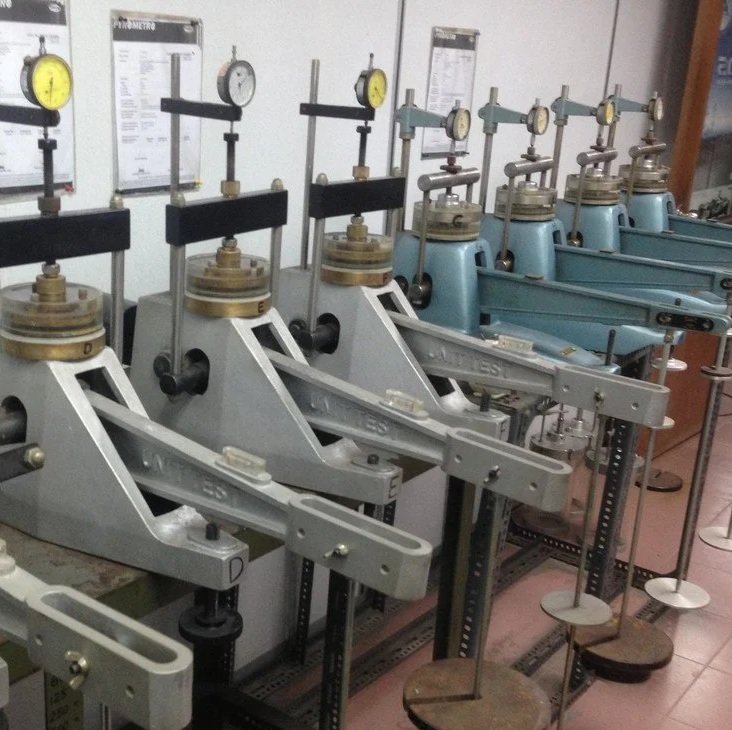
The 1D Consolidation test is performed on a circular disc of soil that is cut from undisturbed U100 or piston tube samples that are recovered in boreholes. The test simulates staged loading conditions to reflect the stress range of interest, and is completed with an unloading stage that allows the soil to swell. The test is used to determine the compressibility, consolidation characteristics and rate of settlement of saturated fine-grained soils (primarily clays and silts), which is used in the design of spread foundations and embankments.
Shear Box Test (Small & Large)
Shear box tests are conducted on specimens cut from undisturbed U100 or block samples, or on representative remoulded samples compacted under laboratory conditions. The small shear box is typically performed on fine-grained soils (silt/clay) and simulates short-term undrained loading conditions, while the large shear box is used for coarser materials (sand/gravel) and simulates drained conditions.
The soil sample is sheared along a predetermined horizontal plane at a constant rate until failure occurs, while the applied lateral stress/shear force and displacement are measured. The tests determine the undrained shear strength and stress-strain behaviour of the soil under short-term loading conditions, and are used to derive the cohesion (c) and angle of internal friction (φ) parameters, which inform the design of foundations, retaining walls and slope stability analysis.
Consolidated Undrained and Drained Triaxial Tests
(Multi-stage 105mm or set of 3x38mm specimens)
Consolidated drained and consolidated undrained triaxial tests are performed on undisturbed U100/piston tube samples with multi-stage loading or three individual U38 specimens of clay soils. During each load cycle, the specimens are allowed to consolidate under a given pressure before shearing forces are applied at a controlled rate to simulate undrained or drained loading conditions, with measurement of pore water pressures. The test determines effective stress strength parameters (c’) and (φ’) that are used for long-term slope stability analysis for cuttings and embankments, design of deep excavations, spread foundations and retaining walls.