
Borehole tests
-
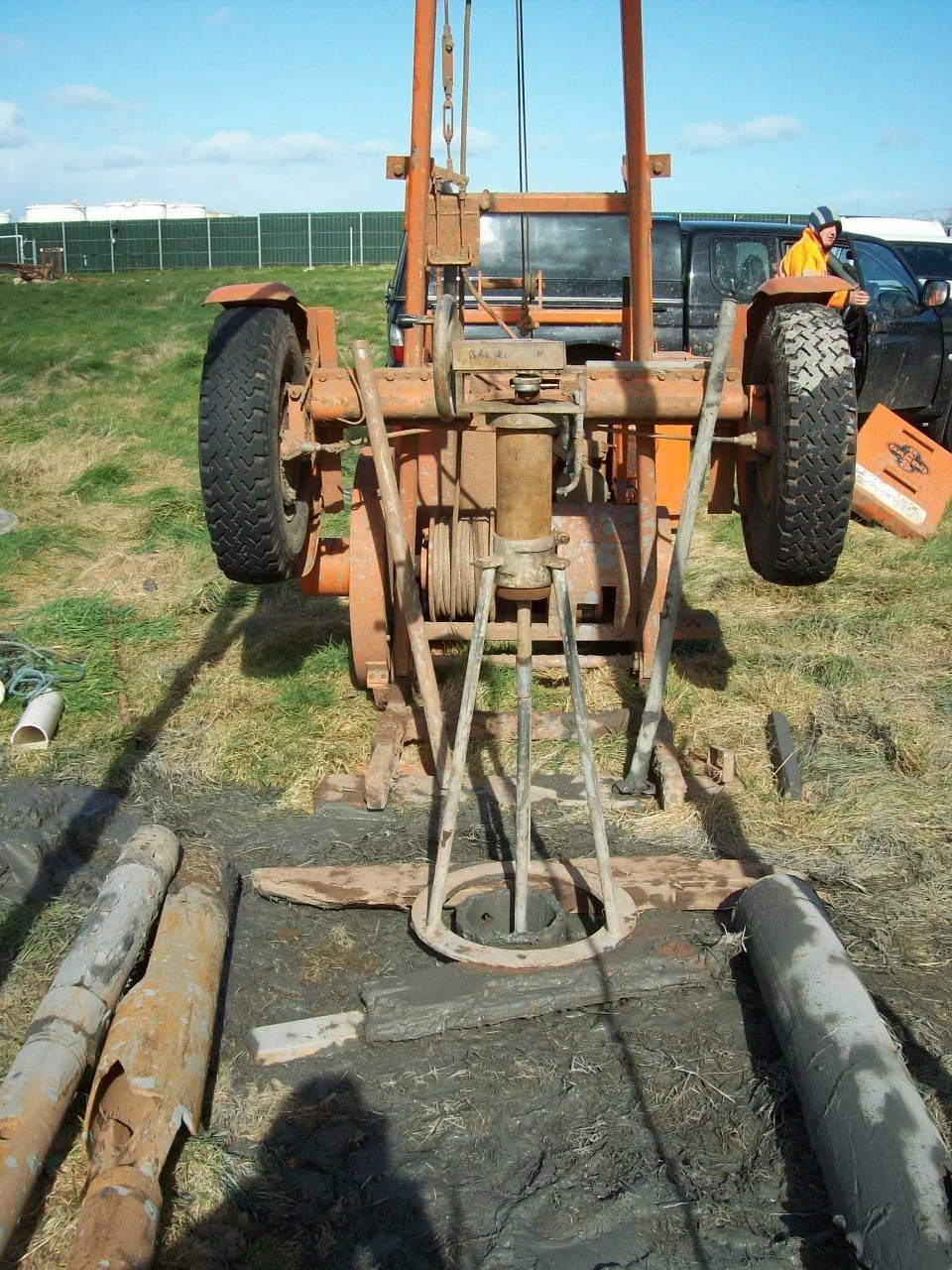
SPT tests are routinely undertaken in boreholes. Following ICE Specification, they are typically undertaken at 1m depth intervals to 5m depth increasing to 1.5m intervals thereafter. The tests are either undertaken using a 450mm long split spoon sampler or solid cone (depending on the stiffness and stone content of the formation), which is lowered to the bottom of the borehole on cylindrical drill rods. The sampler is then driven into the ground using a calibrated 63.5kg sliding hammer free falling exactly 760mm, where the number of blows required to advance the sampler in 75mm increments, over an initial 150mm (seating blows) and 300mm drive blows is recorded as an SPT N Value. The test is then related to the stiffness and relative density of the subsoils
-
Dynamic probe (DPSH & DPH) tests are often undertaken alongside window sampling boreholes or commenced from the base of a borehole, where probes can be advanced to depths of up to 20m in favourable ground conditions. The tests record the number of blows required to advance the probe in 100mm increments, where blow counts are typically plotted as a histogram chart. This reflects the variation in soil stiffness/density with depth, where the data can be calibrated with in-situ SPT tests in boreholes
-
The borehole vane test allows accurate in-situ measurements of the undrained shear strength of soft and sensitive clay soils to be undertaken at depth, where it is often used alongside CPTu tests in estuarine and offshore environments. The equipment uses a four bladed shear vane (typically 62.5mm diameter) that is lowered down the hole on rods and rotated at a controlled rate, when the peak reading at failure is recorded by a torquemeter that is correlated with undrained shear strength. The vane is then rotated in opposite direction for ten revolutions to remould the material, before repeating the test to record the residual shear strength
-
Falling or rising head permeability tests in boreholes are undertaken in accordance with BS 5930 & 22282. The method allows the in-situ hydraulic conductivity of soils to be determined in standpipe installations or at different depths during drilling operations, when a section of casing is withdrawn to expose a known cross-sectional area of the soil layer in the base of the hole. At the start of the test the hole is either filled with water from a bowser or drawn down using a submersible borehole pump, when the time and water level is recorded. The fall or rise in water level is then recorded at different time intervals using a dip meter or data logger, where the intake rate is plotted and used to calculate the soil permeability value from Hvorslev formula
-
Borehole pumping tests are undertaken in accordance with BS14686 and are used to determine the hydraulic conductivity, transmissivity and storage capacity of water bearing superficial deposits, where additional monitoring wells installed with dataloggers are used to measure the drawdown effect and zone of influence of the well. Water levels are then drawn down using a submersible pump that is either operated at a constant flow rate or as a stepped drawdown method, where the tests are run over a 48hour period, followed by a recovery stage. Pumping Tests can also determine the effects of pumping or a reduction in groundwater level on superficial aquifers and can be used to inform the design of well pointing operations